

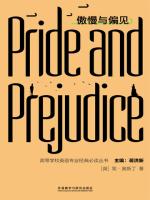
"Pride and Prejudice
用户819538
It is excellent for girls to read Pride and Prejudice before marriage.
The protagonist Elizabeth says: "It is a truth universally
acknowledged, that a single man in possession of a good fortune must be
in want of a wife" — no, wait, her core belief is: "Never
marry without love." Indeed, this is choosing a partner to grow old
with, a loved one you actively select as family. Mr. Yang Jiang said:
"Marriage is the only time you get to personally choose your
family; it’s like choosing your reincarnation with your eyes wide
open." The first reincarnation is destined, but the second is of
your own making. Over 200 years ago, Jane Austen told us through her
words: dare to pursue love. If someone asks you: "Love or bread —
which would you choose?" Mature people don’t choose; we want both.
Love and bread are indispensable. Those who blindly claim "love is
enough to sustain you" may not starve if they "drink only
water" after marriage, but they will surely complain. For daily
life will be filled with trivial household chores and chaos, and love
cannot be eaten as food. This insight likely stemmed from Jane Austen’s
own painful experiences with love. Elizabeth and Darcy, Jane and Bingley
— these are perfect unions: love, wealth, and happiness combined. As the
saying goes, "Economic base determines superstructure" — the
same applies to running a family. Without material support, life becomes
unsustainable. "When a couple is poor, all matters breed sorrow;
sitting idle, I grieve for you and for myself." Shi Tiesheng
said: "Those who have written screenplays know that to make a drama
engaging, there must be conflicts — clashes between characters. The
premise of conflict lies in the characters’ differing personalities,
circumstances, even polar opposites. God understands this well, which is
why the 'drama of human life' is so fascinating." Sparks fly from
the collision of contradictions. The first meeting between the hero and
heroine at the ball was not harmonious; instead, they looked down on
each other — a clash between Darcy’s arrogance as a member of the upper
class and Elizabeth’s prejudice as a middle-class woman. The emergence
and resolution of these conflicts gradually unified as the gripping
story unfolded, making the twists and turns so compelling. Wickham, who
pretended to be "charming and elegant," maliciously slandered
Darcy, deepening Elizabeth’s prejudice against him. Darcy looked down on
the ill-bred Bennet family, yet Elizabeth’s beautiful eyes still
captured his heart. Darcy’s confident proposal was coldly rejected,
forcing him to recognize Elizabeth’s uniqueness and understand her
prejudice. He then wrote a letter to clear his name and expose Wickham’s
pretense. It turns out that "first impressions" are not always
reliable. Darcy appeared arrogant and rude, but he was kind and upright
at heart; Wickham spoke eloquently, yet he was a hypocrite who cheated
people out of their money. Therefore, we should not rush to conclusions
about people or things. Truly strong and unpretentious people need no
pretense — they don’t fawn, don’t speak flattery, and even do good deeds
in obscurity. It was this Darcy, who disregarded class differences and
cherished love and hated evil clearly, that ran unhesitatingly toward
Elizabeth. Lydia and Wickham’s elopement brought shame to the entire
family. It was Darcy who spent money and effort to resolve the issue,
satisfying Lydia and Wickham’s desires and allowing them to get what
they wanted, leading to a happy ending for all. Confucius said:
"Now, when I look at people, I listen to their words and observe
their actions." A man who can take action is more genuine and
reliable than one who indulges in empty talk. Darcy and Wickham’s moral
characters stand in stark contrast — Wickham’s meanness only highlights
Darcy’s nobility. Love is mutual and commensurate. Only those who are
capable can perceive love, give love, and receive love.

 京公网安备 11010802032529号