


。
用户870636
The Indispensable Art of Clarity: A Review of The Elements of Style In
the vast landscape of writing guides, where voluminous tomes often
intimidate rather than instruct, The Elements of Style stands as a
remarkable exception—a slender volume that punches far above its weight.
Originally composed by William Strunk Jr. for his English composition
courses at Cornell University, and later refined by E.B. White, this
modest book has achieved near-mythical status among writers, editors,
and educators. Its enduring relevance across nearly a century speaks not
merely to its utility, but to its profound understanding of what
constitutes effective communication. The book's most striking
characteristic is its uncompromising brevity. Strunk famously advised
his students to "omit needless words," and he practiced this
philosophy with almost religious devotion. The entire volume can be
consumed in a single sitting, yet its principles require a lifetime to
master fully. This paradox lies at the heart of its genius: true writing
proficiency emerges not from complexity, but from the disciplined
elimination of clutter. The fourth edition, which includes White's
elegant introduction and an updated chapter on usage, maintains this
economy while addressing contemporary linguistic concerns. At merely 105
pages, it remains the most efficient investment any serious writer can
make in their craft. The organizational structure reveals Strunk's
pedagogical brilliance. The book divides into five distinct sections:
elementary rules of usage, elementary principles of composition, a few
matters of form, words and expressions commonly misused, and an approach
to style. This progression mirrors the writer's journey—from mechanical
correctness to artistic expression. The opening chapters establish
foundational grammar through imperative declarations that brook no
argument: "Form the possessive singular of nouns by adding
's," "In a series of three or more terms with a single
conjunction, use a comma after each term except the last." These
are not suggestions but commands, delivered with the authority of a
master craftsman who has seen too many promising sentences destroyed by
preventable errors. What elevates The Elements of Style beyond mere
grammar manual is its treatment of composition as architecture. Strunk
approaches paragraph construction with the same rigor an engineer
applies to bridge design. His principle of the "topic
sentence"—that each paragraph should open with a sentence
indicating its subject and purpose—transforms chaotic prose into
navigable text. His insistence on active voice ("The active voice
is usually more direct and vigorous than the passive") and positive
statements ("Make definite assertions") addresses not merely
grammatical preference but psychological impact. Readers, he understood
unconsciously, respond to confidence and clarity; hesitant, convoluted
prose breeds mistrust even when its content proves sound. The famous
"List of Misused Words" demonstrates the authors' prescient
understanding of linguistic evolution. Entries on "hopefully,"
"literally," and "unique" anticipate debates that
would consume editorial boards decades later. While some critics dismiss
Strunk and White as prescriptivist dinosaurs resisting natural language
change, this characterization misrepresents their project. They do not
oppose evolution; they oppose imprecision. When they caution against
using "contact" as a verb or "fix" to mean
"predicament," they champion semantic clarity over fashionable
ambiguity. In an era of algorithmic communication and character-limited
expression, this defense of exactitude feels increasingly urgent.
White's contribution deserves particular appreciation. His added
chapter, "An Approach to Style," transcends technical
instruction to address the writer's relationship with language.
"Style is an increment in writing," he observes, "and it
grows out of the subject, the writer's respect for the reader, and the
writer's respect for the language itself." This philosophical
dimension transforms the book from reference manual to literary
meditation. White reminds us that rules, however essential, serve
ultimately as scaffolding for genuine expression. The young writer
masters mechanics to forget them; the mature writer internalizes
principles so completely that they become instinctive. Contemporary
critiques of the book merit consideration. Some linguists argue that its
examples occasionally reflect outdated class prejudices, privileging
certain dialects over others. Others note that its rigid prohibitions
against split infinitives and sentence-ending prepositions derive from
Latin grammar ill-suited to English's Germanic structure. These
objections contain partial truth, yet they risk missing the forest for
individual trees. Strunk and White never claimed to codify immutable
linguistic law; they offered practical guidelines for specific
contexts—primarily academic and professional writing where clarity
supersedes colloquial charm. The book's physical manifestation
reinforces its philosophy. The compact format, generous margins, and
uncluttered typography embody the very clarity it preaches. One cannot
handle this volume without unconsciously absorbing its aesthetic
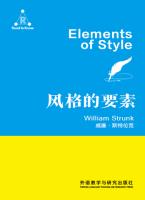
principles. The current edition's blue and yellow cover, instantly
recognizable on any writer's shelf, has become a badge of professional
seriousness. For the contemporary English learner, particularly those
navigating the complexities of academic writing in a second language,
The Elements of Style offers invaluable orientation. Its examples, drawn
from student compositions, address precisely the errors non-native
speakers encounter: excessive nominalization, misplaced modifiers, vague
pronoun references. The Chinese edition, maintaining the original's
concision while providing necessary cultural context, proves especially
effective for students transitioning between rhetorical traditions. In
conclusion, The Elements of Style remains essential not because it
captures language in amber, but because it distills writing to its
communicative essence. In an age of information overload, where readers
face unprecedented textual volume, the ability to convey complex ideas
with simplicity constitutes genuine power. Strunk and White teach us
that style is not decorative flourish but moral obligation—a respect for
the reader's time and intelligence. As White memorably concluded:
"The whole duty of a writer is to please and satisfy himself, and
the true writer always plays to an audience of one. Let him start
sniffing the air, or glancing at the Trend Machine, and he is as good as
dead, although he may make a nice living." Every writer's desk
deserves this book. Every writer's mind deserves its principles.

 京公网安备 11010802032529号