

风格的要素书评
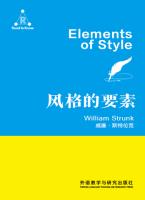
Among countless writing guidebooks in English literary and academic history, few can maintain enduring influence like The Elements of Style by William Strunk Jr. and E.B. White. First composed as a brief instructional manual and later revised and popularized into a classic handbook, this slim yet powerful volume has long been regarded as the “bible of English writing.” It does not indulge in complicated literary theories or verbose academic discussions. Instead, it focuses on practical, fundamental, and timeless principles of writing clarity, simplicity, and discipline. After thoroughly reading and reflecting on this book, I have gained a completely new understanding of what good writing truly means and how writers can reshape their language habits to achieve precision and elegance.
The most impressive feature of The Elements of Style is its core principle: simplicity and brevity are the soul of effective writing. In modern writing practice, many people mistakenly believe that sophisticated vocabulary, lengthy sentences, and complicated grammatical structures represent advanced writing skills. They tend to pile up modifiers, use redundant phrases, and pursue ornate expressions in order to make their compositions look more professional or academic. However, Strunk and White strongly oppose this tendency. The book repeatedly emphasizes that vigorous writing is concise writing. Every word that serves no purpose, every redundant expression, and every vague phrase weakens the power of language. Good writing, as the book suggests, should eliminate unnecessary words, avoid wordiness, and present ideas directly and clearly.
The book lists precise and practical rules that target common writing problems. For example, it requires writers to avoid loose sentences, to use active voice rather than passive voice whenever possible, to omit needless words, and to keep paragraphs unified and coherent. These rules seem simple and basic, yet they are frequently violated by both student writers and even experienced authors. Many people overlook the fact that unclear expression usually results from laziness in word choice and sentence arrangement rather than lack of vocabulary. By pointing out these common mistakes, The Elements of Style helps readers realize that writing improvement does not rely on accumulating fancy expressions but on cultivating rigorous language awareness.
Another valuable idea in this classic work is the emphasis on accuracy and honesty in language. The authors argue that writing should faithfully reflect the writer’s thought. Language is a tool for communication and expression, not a tool for disguise or exaggeration. Many writers habitually use vague generalities, overstatements, and abstract clichés to fill paragraphs, making their writing empty and unconvincing. Strunk and White remind readers that concrete details, specific expressions, and truthful descriptions are the foundation of powerful writing. A genuine and simple sentence is always more touching and persuasive than a flowery but hollow paragraph. This principle not only improves writing skills but also shapes writers’ critical thinking and sincere attitude toward creation.
Furthermore, The Elements of Style teaches readers the importance of discipline and taste in writing. Writing freedom does not mean randomness or arbitrariness. True literary freedom is built on the mastery of basic rules and stylistic norms. Only after fully understanding grammatical principles, sentence structures, and stylistic conventions can writers break rules reasonably and form their own unique style. The book wisely points out that style is not a superficial decoration; it originates from the writer’s thinking habit, observation ability, and language cultivation. Elegant style comes from clear logic, sincere emotion, precise wording, and orderly arrangement rather than deliberate modification. This view corrects the common misunderstanding that “style equals decoration”.
What makes this book timeless is its strong applicability across eras. Although modern English has developed new expressions and internet language has enriched daily communication, the fundamental logic of effective writing never changes. In an era flooded with fragmented online content, people are increasingly used to vague, casual, and redundant expressions. Short internet posts, informal chats, and rapid information output gradually lower people’s standards for language accuracy. Under such circumstances, the principles proposed in The Elements of Style become even more precious. It urges modern writers to pursue clarity, logic, conciseness, and accuracy amid casual and disorderly linguistic environments.
In addition, the book cultivates readers’ aesthetic judgment toward language. It helps writers distinguish between clumsy wording and refined expression, between disorderly structure and unified organization, between redundant narration and concise presentation. After learning these rules, readers can consciously polish sentences, adjust paragraph layouts, eliminate common errors, and gradually form steady and elegant writing habits. For English learners and student writers especially, this book provides the most reliable basic training. It builds a solid foundation for academic writing, essay composition, formal communication, and literary creation.
Nevertheless, while recognizing its great value, we should also view this book from a dialectical perspective. Some readers argue that a few rules in The Elements of Style seem overly rigid for contemporary creative writing, especially literary fiction and free prose, which allow more flexible sentence structures and stylistic diversity. However, this does not reduce the book’s value. The authors’ purpose is to standardize basic writing habits rather than restrict literary creativity. Mastering standard rules allows writers to use flexible techniques more appropriately. Rules lay the foundation, while creativity builds the height.
In conclusion, The Elements of Style is far more than a writing handbook. It is a guide for linguistic cultivation and logical thinking. It teaches writers to pursue clarity, simplicity, accuracy, and sincerity in language, to abandon redundancy and pretension, and to respect the purity and power of words. Every writer, whether beginner or experienced, can continuously benefit from its principles. This classic work reminds us that excellent writing is never born out of accidental talent, but out of rigorous training, persistent polishing, and serious respect for language. It is precisely these timeless standards of good writing that make The Elements of Style an enduring classic that transcends time and literary trends.

 京公网安备 11010802032529号