

1
郑蓉伊
As a milestone achievement of the Project on Disseminating Key
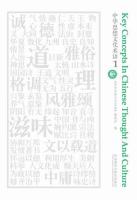
Concepts of Chinese Thought and Culture, Key Concepts In Chinese Thought
Volume 1 is compiled by top scholars in Chinese history, philosophy and
translation including Yuan Jixi and Huang Youyi. It is a cultural
reference book that balances strict academic standards and popular
reading value. The entry “kējǔ (the Imperial Civil Examination System)”
fully shows the book’s unique writing logic and value for cross-cultural
communication. This book mainly explains basic cultural concepts
formed before the Wei and Jin dynasties, and also tracks how their
meanings changed in later ages. It breaks people’s fixed, one-sided
understanding of traditional Chinese terms. Take the imperial civil
examination system as an example. The entry sorts out its complete
history: its birth in the Sui Dynasty, the eight-legged essay format
finalized in the Yuan and Ming dynasties, and its official abolition in
the late Qing Dynasty. It clearly explains how this system helped China
shift from aristocracy-based politics to bureaucracy-based politics, and
adds ancient quotes from historical books to support its analysis.
Unlike rigid ancient classics, this book connects Confucianism, Taoism,
Buddhism, Chinese history and Western philosophy. It points out that the
same word can carry totally different meanings in different schools or
eras. For instance, it compares the different definitions of “Dao”,
“rule of law” and “fengjian” in different periods, solving the common
confusion many readers face when reading ancient texts. The
outstanding editorial team guarantees the book’s quality. Specialists in
Chinese traditional studies, philosophy and translation work together,
making the content both historically profound and accurately translated
into English. Every term comes with standard, natural English
explanations written at a US high school reading level. College students
can use it to improve their bilingual ability in traditional culture,
while overseas readers can easily grasp ancient Chinese systems. The
translation of “kējǔ” does not use stiff word-for-word translation.
Instead, it adopts the internationally recognized phrase “the Imperial
Civil Examination System” to capture the core of this ancient
official-selection system. Its English paragraphs avoid complicated
sentence structures, balancing academic precision and readability.
Nowadays, cross-cultural communication has become increasingly
important. Many young college students hope to introduce Chinese culture
to foreign audiences, yet they struggle to find simple, standard
bilingual explanations. This book perfectly fills this gap. It avoids
obscure theories and uses single cultural terms as entry points to link
thousands of years of Chinese thought, institutions and history. The
entry about the imperial civil examination system alone covers ancient
education, talent selection, social stratification and cultural
inheritance, allowing readers to understand how ancient Chinese society
operated. In short, this bilingual book is a must-read for college
students. It helps us clarify confusing traditional cultural concepts
and enrich our humanistic knowledge. More importantly, it teaches us to
tell Chinese stories in standard, accessible English, making it an
excellent material for domestic cultural study and international
cultural exchange.

 京公网安备 11010802032529号