

中华文化读本
用户871263
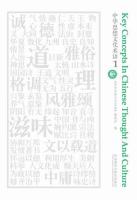
Book Review: Key Concepts in Chinese Thought And Culture (Volume 1)
Key Concepts in Chinese Thought And Culture (Volume 1), compiled by a
committee led by Yuan Jixi, is a landmark publication of the Project for
the Dissemination of Key Concepts in Chinese Thought and Culture.
Tailored for American high school readers, this book goes far beyond a
simple glossary of cultural words. It offers in-depth interpretations of
fundamental cultural ideas from pre-Wei and Jin dynasties in ancient
China, such as ren (benevolence), de (virtue), fengjian (feudalism),
Huaxia, and yin-yang. The greatest strength of this book lies in its
historical perspective. It clearly traces the shift of word meanings
over time, helping readers avoid common misunderstandings. For instance,
it points out that the ancient Chinese idea of fazhi (rule of law) is
not identical to the modern Western concept of the rule of law.
Similarly, the original meaning of fengjian in the Zhou Dynasty differs
greatly from the later usage of the term in modern historical research.
The book also compares how Confucianism and Daoism interpret the same
word Dao: Confucian Dao focuses on benevolence, rituals and music, while
the Daoist Dao is formless and invisible. By connecting Confucianism,
Buddhism, Daoism and Western philosophy, the editors build a complete
logical system of traditional Chinese ideas. Instead of listing
isolated terms mechanically, the book links these concepts together to
show the shared beliefs and spiritual pursuits of the Chinese nation.
Every term reflects how ancient Chinese people observed the world and
formed their values. The language is concise and reader-friendly,
perfectly matching the reading level of American high school students.
It balances academic accuracy and readability, making profound
philosophical ideas easy to understand for overseas readers without
losing cultural depth. For Chinese learners and cross-cultural
communicators, this book is extremely valuable. It provides
standardized, natural English translations for culture-specific terms,
solving the problem of semantic loss in cross-cultural communication. It
helps foreign readers break free from superficial stereotypes and grasp
the core spirit of Chinese civilization. Meanwhile, Chinese readers can
also gain a clearer view of our own traditional culture from an
international perspective. In conclusion, Key Concepts in Chinese
Thought And Culture (Volume 1) is more than a vocabulary book. It serves
as a bridge between Eastern and Western civilizations. It faithfully
records the evolution of Chinese ideas and passes down our long-standing
cultural heritage. I highly recommend this book to anyone who takes an
interest in Chinese philosophy, history and traditional culture

 京公网安备 11010802032529号