

Book review
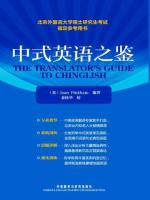
For most Chinese English learners, Chinglish is an unavoidable barrier in English writing and translation. Despite years of systematic study of vocabulary, grammar and sentence patterns, many students still produce stiff, unnatural and unidiomatic English. In this case, The Translator’s Guide to Chinglish serves as a professional and practical guide that thoroughly analyzes the root causes of Chinglish and offers effective solutions for learners to polish their language ability.
Different from ordinary English textbooks that focus on basic grammar rules, this book targets the invisible errors caused by negative language transfer. The core difference between Chinese and English thinking is fully illustrated in the book. Chinese writing tolerates repetition, redundant modifiers and vague expressions to pursue a full and gentle tone. On the contrary, native English adheres to the principles of conciseness, accuracy and logical rigor. Many sentences that seem grammatically correct are actually typical Chinglish, because they are mechanically translated from Chinese thinking without conforming to English linguistic habits.
The book is highly instructional due to its abundant authentic examples and targeted revisions. The author classifies common Chinglish problems into clear categories, such as redundant nouns, unnecessary verbs, repetitive meanings and awkward collocations. By comparing defective sentences with polished standard versions, readers can directly spot their habitual mistakes. For instance, many learners habitually add meaningless modifiers to enrich sentences, which only makes the writing verbose and disordered. This book helps us realize that qualified English writing requires subtraction rather than blind addition of words.
Moreover, this book brings me profound changes in language cognition. I used to believe that excellent writing depends on advanced vocabulary and complex clause structures. However, this book corrects this wrong notion. True high-level English expression is simple, precise and logical. Blindly pursuing gorgeous words will only make the writing pretentious and unnatural. Only by abandoning Chinese fixed thinking and establishing pure English logic can we achieve authentic expression.
In addition, the book is of great value for English majors. It not only improves daily writing and translation skills, but also cultivates cross-cultural linguistic awareness. It reminds us that language learning is not mechanical imitation, but the transformation of thinking modes.
To sum up, The Translator’s Guide to Chinglish is a classic and essential reference book. It helps learners get rid of Chinglish shackles, standardize language expression and form correct English thinking. It is undoubtedly a precious resource for every English learner to achieve progressive and professional language improvement.

 京公网安备 11010802032529号